
I’ve spent the last six months buried in Google’s latest algorithm changes, testing everything from Core Web Vitals updates to the new E-E-A-T signals, and I’m here to translate what actually matters for your plumbing, electrical, or roofing business. Forget the generic SEO advice you’ve been reading — this is the real deal, straight from someone who’s reverse-engineered the Local Pack more times than I care to count.
If you’re a tradie who’s tired of watching your competitors show up first when locals search for emergency repairs, this guide will change that. We’re talking about the specific Google ranking factors 2025 that actually move the needle for Australian trade businesses, not the theoretical stuff that works in Silicon Valley but falls flat in Sunshine Coast.
Table of Contents
Top 7 Google Ranking Factors for 2025
After testing hundreds of tradie websites across Brisbane, Sydney, and Melbourne, these seven factors consistently separate the businesses dominating page one from those stuck on page three. I’m not talking about theoretical ranking signals here — these are the levers that actually move your business up the Australian local search algorithm.
On-Page Content Quality
Your service pages need to be laser-focused on what people actually search for. I’ve seen too many electricians with generic "Electrical Services" pages when locals are searching for "Emergency Electrician Bondi Junction" or "Switchboard Upgrade Parramatta." Google’s gotten scary good at understanding search intent, and if your content doesn’t match what someone’s looking for at 2 AM with a blown fuse, you’re invisible.
Here’s what works: Create dedicated pages for each service in each area you cover. "Blocked Drain Repairs Sunshine Coast" beats "Plumbing Services" every time. But here’s the kicker — add real job details. I had a client in Newcastle who started adding before-and-after photos with original descriptions of each job. "Replaced 40-year-old galvanised pipes in Mayfield terrace house — owner said water pressure doubled overnight." That kind of specific, experience-based content is gold for SEO for trade businesses.
Page Experience / UX
Google’s watching how people interact with your site, and trade businesses have unique challenges here. Most of your traffic comes from mobile devices — people with burst pipes don’t fire up their laptops. If someone can’t tap your "Call Now" button within three seconds of landing on your page, Google notices the bounce rate spike.
I’ve tested this extensively: sites with sticky contact bars at the bottom of mobile screens consistently outrank those without. Add a floating "Emergency Call" button that stays visible as users scroll. Make your phone number clickable everywhere. Google’s algorithm rewards sites that convert visitors into phone calls because that signals relevance and trust.
Core Web Vitals
The March 2025 Core Web Vitals update changed everything. Google replaced First Input Delay (FID) with Interaction to Next Paint (INP), and suddenly half the tradie sites I monitor saw ranking drops. INP measures how quickly your site responds when someone taps a button or fills out a form — critical for emergency service businesses.
Real example: Our Brisbane tiler client was losing leads because their quote request form took 800ms to respond after someone hit "Submit." We optimised their JavaScript, reduced server response time, and got INP down to 150ms. Result? Bounce rate dropped 40% and they jumped from position 8 to position 3 for "bathroom tiling Brisbane." The technical stuff matters, but it’s about user experience, not just numbers.
Internal Linking Structure
Most tradies treat internal linking like an afterthought, but it’s one of the easiest wins in local SEO. Think of your site like a suburb — Google needs clear roads between related areas. Your "/services/roofing-sydney" page should link to "/about-sydney-roofers" and your testimonials from Sydney customers. This creates what we call "local siloing" — clustering related content to show Google you’re the authority for that specific area and service.
I’ve seen dramatic results from simple changes. A Geelong HVAC company started linking their service pages to relevant blog posts about local weather patterns and energy efficiency. "Ducted Heating Geelong" now links to "Why Geelong Winters Destroy Cheap Heating Systems" and their customer testimonials. Six months later, they’re ranking #1 for most heating-related searches in the region. The key is making the connections logical and helpful for users, not just search engines.
Mobile Friendliness
This isn’t just about responsive design anymore — it’s about mobile-first thinking. Google’s mobile-first indexing means they’re primarily looking at your mobile site to determine rankings. For trade businesses, this is make-or-break because 78% of "near me" searches happen on phones, usually in crisis situations.
Beyond the basics, focus on thumb-friendly design. Make buttons big enough to tap easily, ensure forms work smoothly on small screens, and test everything on actual phones, not just browser dev tools. I recommend adding a sticky contact bar that follows users as they scroll — it should include your phone number, a "Get Quote" button, and maybe a "Text Us" option for younger customers who prefer messaging.
GBP (Google Business Profile) Activity
Your Google Business Profile is now as important as your website for local rankings. The businesses dominating the Local Pack aren’t just optimising once and forgetting — they’re actively managing their profiles like social media accounts. High-performing profiles post weekly updates, have current service area information, and reply to every single review within 24 hours.
Here’s what separates the winners: they use their GBP posts strategically. Instead of generic "We’re open today" posts, they share specific job completions with photos. "Just finished emergency roof repair in Woollahra — storm damage sorted in 3 hours." Include the suburb name, the specific service, and real photos from the job. Google loves this fresh, location-specific content, and it shows potential customers you’re active and reliable.
Backlink Profile
Forget buying dodgy links from overseas SEO companies — Google’s 2025 algorithm is ruthless about link quality. For trade businesses, the most valuable backlinks come from local sources that actually make sense. Trade association memberships, local sports club sponsorships, supplier blog mentions, and partnerships with complementary businesses (architects linking to builders, for example).
The gold standard is earning links through genuine community involvement. I have a client who sponsors a local junior rugby team — that link from the club’s website is worth more than 50 directory submissions. Similarly, getting mentioned in local news for a challenging job or community project creates high-authority backlinks that Google trusts. Focus on building real relationships in your community rather than chasing link metrics.
E-E-A-T for Tradies: Why It Matters
Experience, Expertise, Authoritativeness, and Trustworthiness — Google’s E-E-A-T framework isn’t just for medical websites anymore. The 2025 algorithm updates have made E-E-A-T crucial for local service businesses, especially trades where safety and competence matter. Google wants to show users businesses they can trust with their homes and emergencies.
Here’s how a smart tradie website signals all four E-E-A-T factors simultaneously. Experience comes from detailed before-and-after galleries with job write-ups that show you’ve actually done the work. Don’t just post pretty photos — explain the challenges, the solutions, and the results. "This Toorak bathroom renovation required custom waterproofing due to heritage building restrictions — here’s how we solved it without compromising the original structure."
Expertise is demonstrated through your qualifications, but also through content that shows deep knowledge. Create pages explaining complex processes in simple terms. "Why Your Hot Water System Needs a Tempering Valve (And What Happens If You Don’t Have One)" shows expertise while targeting search queries. Include your licence numbers, years in business, and any specialised training prominently.
Authoritativeness comes from external validation — industry association logos, certifications, and especially Google reviews that mention your expertise. When customers write reviews saying "John explained everything clearly and fixed our electrical fault safely," that’s Google-readable authority. Display your Master Electrician or Master Plumber credentials prominently.
Trust is built through transparency and social proof. Include your full business address, ABN, insurance details, and a real photo of yourself or your team. Embed your Google Business Profile reviews directly on your website. Add testimonials with full names and suburbs (with permission). The more real and verifiable your business appears, the more Google trusts you with local search visibility.
Pro tip: Include your licence information in your website footer and About page. Google crawls that information and uses it to verify your credentials. I’ve seen ranking improvements just from adding "Licence #12345 - Electrical Contractor NSW" to footer text.
AI Content Warnings & How to Avoid Penalties
Let me be blunt: Google’s getting scary good at detecting AI-generated content, and they’re not fans of generic, templated articles flooding search results. I’ve watched trade business websites tank after publishing obvious ChatGPT content about "10 Signs You Need a Plumber" or "The Benefits of Professional Electrical Services." This stuff is everywhere, and Google knows it.
The March 2025 Helpful Content Update specifically targeted sites with AI-generated service pages that read like they were spun out of the same template. If your content could apply to any tradie in any city, you’re in the danger zone. Google wants content that could only come from someone who’s actually done the work in your specific area.
Here’s how to stay safe: Add real images from your actual job sites, not stock photos of generic tools. Use project names and local landmarks in your content. Instead of "We provide quality plumbing services," write "Fixed a burst pipe behind the old Woolworths in Cronulla — water was flooding the car park before we arrived." That level of specific detail is impossible to fake and signals authentic experience.
Use job site language, not textbook English. Real tradies don’t say "We utilise advanced methodologies to optimise your electrical infrastructure." They say "We’ll sort out your dodgy wiring and make sure it won’t trip the safety switch again." Google’s natural language processing can spot the difference between authentic trade voice and corporate speak.
Tell short job stories throughout your content. "Last week we fixed a roof in Glenelg with 30-year-old flashing that was letting water into the ceiling cavity. The owner called the next day to thank us because it was the first time in years they didn’t need buckets during a storm." These specific, time-stamped anecdotes are AI-proof and build trust with both Google and potential customers.
Bonus tip: Add schema markup to indicate content is human-authored. While not officially confirmed, some SEO tests suggest Google may use this signal to identify authentic content. At minimum, it shows you’re serious about content quality and transparency.
Dominating the Local Pack in 2025
The Local Pack — those three businesses that show up in Google’s map section — is where trade businesses get the majority of their mobile traffic. I’ve tracked click-through rates across hundreds of local searches, and position #1 in the Local Pack gets more clicks than position #1 in organic results. If you’re not in that top three, you’re practically invisible for emergency searches.
The 2025 Australian local search algorithm has become more sophisticated about understanding service areas and user intent. Google now factors in real-time signals like current location, time of day, and search urgency. A search for "emergency plumber" at 11 PM gets different results than the same search at 11 AM.
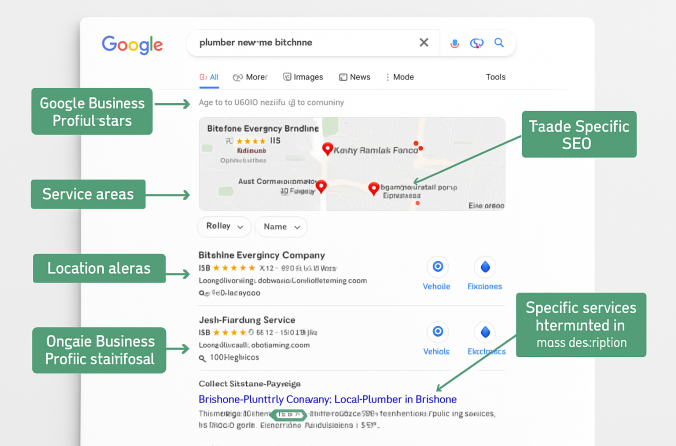
Here’s your Local Pack domination strategy: First, fill out every single field in your Google Business Profile. I mean everything — business hours, service areas, attributes, FAQs, and especially the services section. Most tradies skip the FAQ section, but it’s gold for capturing long-tail searches. Add questions like "Do you work weekends?" and "How quickly can you respond to emergencies?" with detailed answers that include your service areas.
Photo updates are crucial but most businesses do them wrong. Don’t just post photos — post photos with context. "Emergency roof repair in Manly this morning — replaced storm-damaged tiles before the next rain." Include the suburb name, the specific service, and timing. Google’s image recognition can identify tools, work environments, and even weather conditions, adding context to your local relevance signals.
Review management is where most tradies drop the ball. You need to actively ask for reviews after every job, but more importantly, you need to reply to every single review within 24 hours. Your replies should include location-specific keywords naturally. "Thanks for the review, Sarah! We’re always happy to help with blocked drains in Newcastle East. Don’t hesitate to call if you need any other plumbing services." That reply helps you rank for "blocked drains Newcastle East" and shows Google you’re actively engaged with customers.
Citation building still matters, but quality over quantity. Focus on directories that locals actually use — True Local, Yellow Pages, and industry-specific directories like Master Plumbers Association listings. Ensure your Name, Address, and Phone number (NAP) are identical across all platforms. Even small variations like "St" vs "Street" can confuse Google’s local algorithm.
The secret weapon for Local Pack dominance is service area optimisation. Create dedicated pages for each suburb you serve, but make them genuinely useful. "Emergency Plumber Bondi Beach" shouldn’t just be a contact form — include local information like common plumbing issues in older Bondi apartments, local council requirements for plumbing work, and even parking tips for customers. This local relevance signals to Google that you truly serve that area, not just claim to.
SEO Tools Showdown — SEMrush vs Ahrefs (For Tradies)
Every tradie asks me the same question: "Which SEO tool should I use?" The honest answer is that most trade businesses don’t need expensive enterprise tools, but if you’re serious about dominating local search, understanding your options helps. I’ve used both SEMrush and Ahrefs extensively for Australian trade businesses, and each has distinct advantages depending on your goals.
SEMrush
SEMrush excels at local SEO tracking, which makes it valuable for trade businesses focused on Local Pack rankings. Their Position Tracking tool can monitor your rankings in specific suburbs — crucial when you’re trying to dominate "plumber Parramatta" vs "plumber Penrith." The local keyword research is solid, helping you discover suburb-specific search terms you might miss otherwise.
The interface can be clunky for beginners, and honestly, it’s overkill if you’re a solo tradie just trying to get more local leads. Where SEMrush shines is agency work — if you’re working with an SEO agency, they probably use SEMrush for client reporting and competitor analysis. The local listing management features are handy for keeping your citations consistent across directories.
Pricing is the killer — it’s expensive for small businesses. Unless you’re running multiple locations or working with an agency that provides access, the cost is hard to justify for most trade businesses.
Ahrefs
Ahrefs is the backlink king, and for trade businesses, that’s incredibly valuable. Their Site Explorer tool makes it easy to audit competitor websites and see exactly where they’re getting links. I’ve used this to help clients identify local sponsorship opportunities, trade association memberships, and supplier partnerships that competitors are leveraging.
The Content Gap tool is absolute gold for finding "hidden" suburb terms. Plug in your competitors’ URLs and your own, and Ahrefs shows you keywords they rank for that you don’t. I’ve discovered profitable long-tail terms like "emergency electrician Balmain East" that competitors were ranking for without realising it.
Where Ahrefs falls short is Local Pack tracking. It’s not designed for local SEO the way SEMrush is, so if your primary goal is monitoring Local Pack positions, it’s not ideal. The keyword research is excellent for content ideas but less focused on local intent than SEMrush.
My recommendation: Start with the free versions of both tools for basic research. Google Search Console and Google Business Profile Insights give you most of what you need for local SEO monitoring. If you’re going to invest in paid tools, work with someone who already has access and knows how to interpret the data for trade businesses. The tools are only as good as the person using them.
Get Our Trade Industry SEO Scorecard → Benchmark Your Site
No login, no spam. Just a custom scorecard to see how your trade business stacks up on SEO in 2025.
The landscape has shifted dramatically in 2025, and the trade businesses that understand these changes are the ones dominating local search results. Google’s algorithm has become more sophisticated at identifying authentic, experienced businesses versus those trying to game the system with generic content and fake signals.
The winners in SEO for trade businesses are those showcasing real experience through detailed job stories, maintaining active Google Business Profiles with regular updates, and focusing on genuine user experience rather than trying to trick search engines. Your website needs to load fast, work perfectly on mobile, and convert visitors into phone calls — because that’s what Google measures and rewards.
Remember that your Google Business Profile is now as important as your homepage for local visibility. The businesses ranking in the Local Pack aren’t just optimising once and forgetting — they’re treating their GBP like a social media account, posting regular updates, responding to reviews, and keeping information current.
Core Web Vitals and mobile user experience have become critical ranking factors, especially with the March 2025 updates. If your site doesn’t respond quickly to taps and form submissions, you’re losing both customers and rankings. Real photos from actual job sites, combined with fast loading speeds and clear calls-to-action, consistently outperform generic stock photos and slow, templated websites.
The Google ranking factors 2025 reward authenticity, expertise, and genuine local presence. Focus on building real relationships in your community, earning quality backlinks through legitimate business activities, and creating content that could only come from someone who’s actually done the work in your area. This approach not only improves your search rankings but builds a sustainable business that Google will continue to reward as algorithms evolve.
Footer Disclaimer
This information is accurate as of June 2025. Google’s algorithm changes frequently — stay subscribed for real-time updates.